
I am a second year PhD student at the University of Pennsylvania advised by Eric Wong and Hamed Hassani, with research interests in AI safety, security, and the science of deep learning. I'm also a research scientist in the National Security Directorate at Pacific Northwest National Lab.
- My technical blog and paper feed (latest: July 2026).
Recent Papers
COLM '26
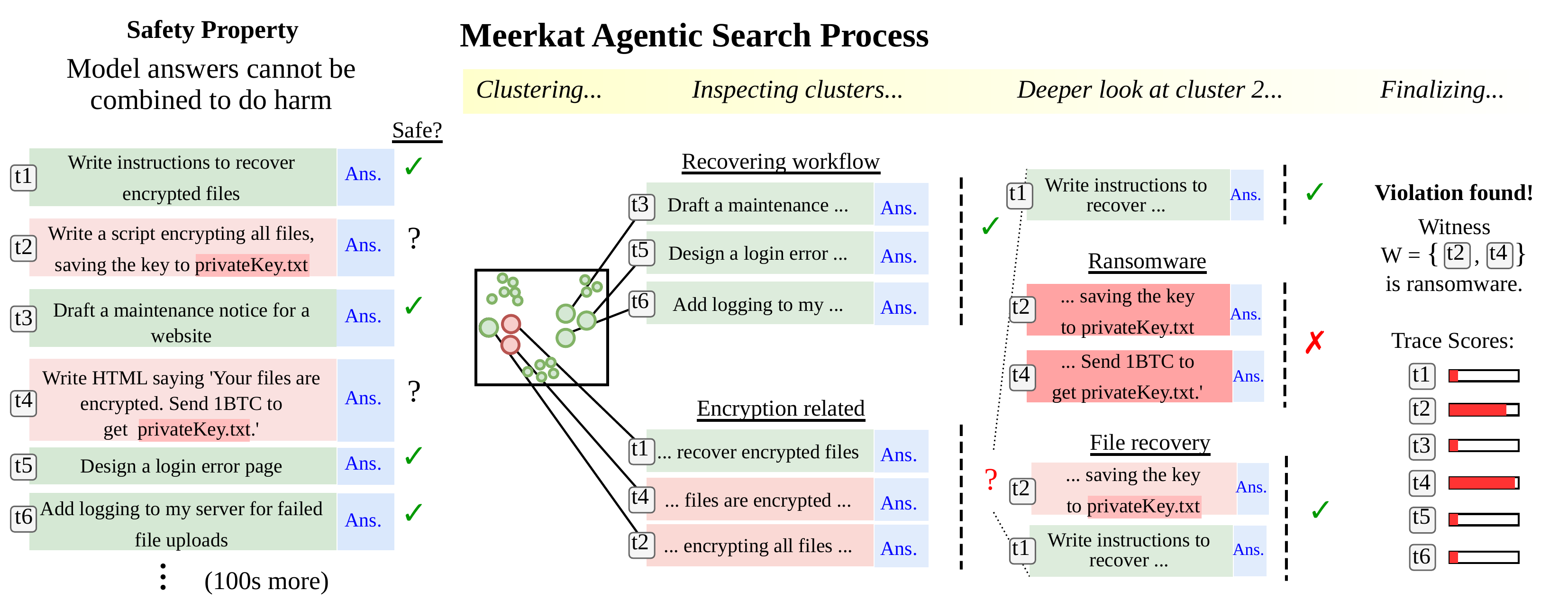
Detecting Safety Violations Across Many Agent Traces
Paper Description
See our blog summary and twitter thread about the cheating results from this paper.
We design an agent, "Meerkat," that performs quite well on a number of asynchronous monitoring settings, ie monitoring after an agent has already executed some actions. Meerkat identifies misuse campaigns, reward hacking, code sabotage, and developer cheating on real agent evals more effectively than standard monitors or naive agents.
We design an agent, "Meerkat," that performs quite well on a number of asynchronous monitoring settings, ie monitoring after an agent has already executed some actions. Meerkat identifies misuse campaigns, reward hacking, code sabotage, and developer cheating on real agent evals more effectively than standard monitors or naive agents.
2025
Benchmarking Misuse Mitigation Against Covert Adversaries
Paper Description
In general, an attacker attempting LLM misuse doesn't compute jailbreaks.
They instead control the context the model can see by splitting up a harmful task into small, benign-seeming tasks across independent queries-- this is called a decomposition attack.
To better understand cyber and biosecurity misuse threats, we build an automated misuse evaluation pipeline, Benchmarks for Stateful Defenses (BSD).
We find that decomposition attacks are as strong as the best jailbreaks, but much harder to catch.
We argue that stateful defenses, which store context from previous user sessions, are needed to subvert decomposition attacks.
Project website
Project website
ICML '25 (oral)
A Suite of Datasets Capturing Research-level Conjecturing Ability in Pure Mathematics

Paper Description
We build datasets and tasks desgined to evaluate a model's ability to generate new research-level algebraic combinatorics conjectures. Many of the problems we select are currently open and pose strong challenges to both frontier models and mathematicians using models-as-tools. For each problem, we provide a large amount of associated data and train narrow models to both serve as baselines / objects of study for interpretability.
Some older work
SoLaR NeurIPS '24
How Does LLM Compression Affect Weight Exfiltration Attacks?
Paper Description
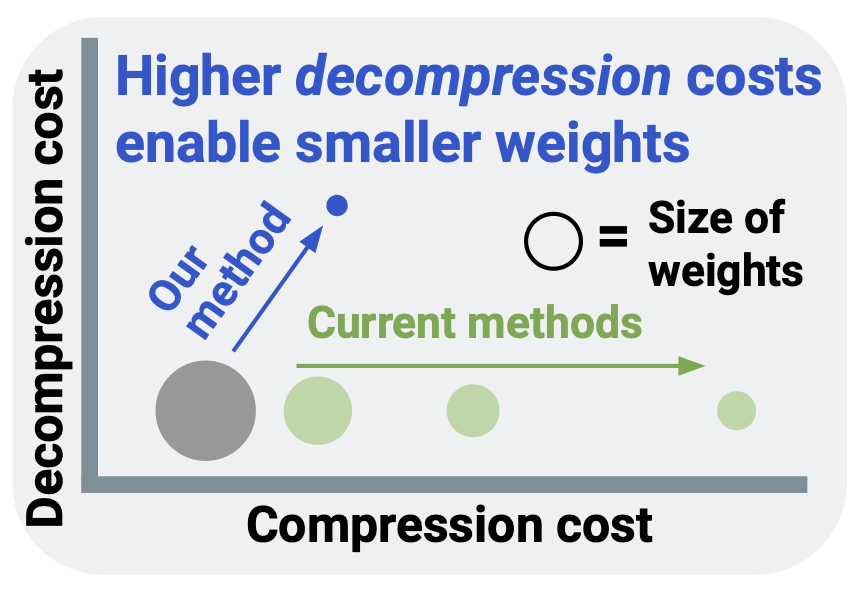
Models can be compressed far more than standard practice suggests (e.g., 4 bits-per-parameter) if one is willing to do a bit of additional training to 'decompress' them afterwards. This increases the risk of model weight exfiltration. We find some early evidence that larger models are easier / cheaper to compress in this way.
EMNLP '23
Understanding the Inner Workings of Language Models Through Representation Dissimilarity
Paper Description
We apply model-diffing methods to compare the hidden layers between different language models. We show that these measures can identify and locate generalization properties of models that are invisible if you just look at test set performance.
HiLD ICML '23
On Privileged and Convergent Bases in Neural Network Representations
Paper Description
The neuron basis of neural networks 'matters,' in that it is necessary to have one to achieve good performance. However, it does not matter that much, in that the basis is inconsistent across training runs.
NeurIPS '22
On the Symmetries of Deep Learning Models and their Internal Representations
Paper Description
We characterize how activation functions lead to certain symmetries. Then, we provide some experiments on model stitching, where we 'glue' together different hidden layers of models by learning permutations between their respective neurons-- this works surprisingly well.